




Medrolin®
Medrolin®
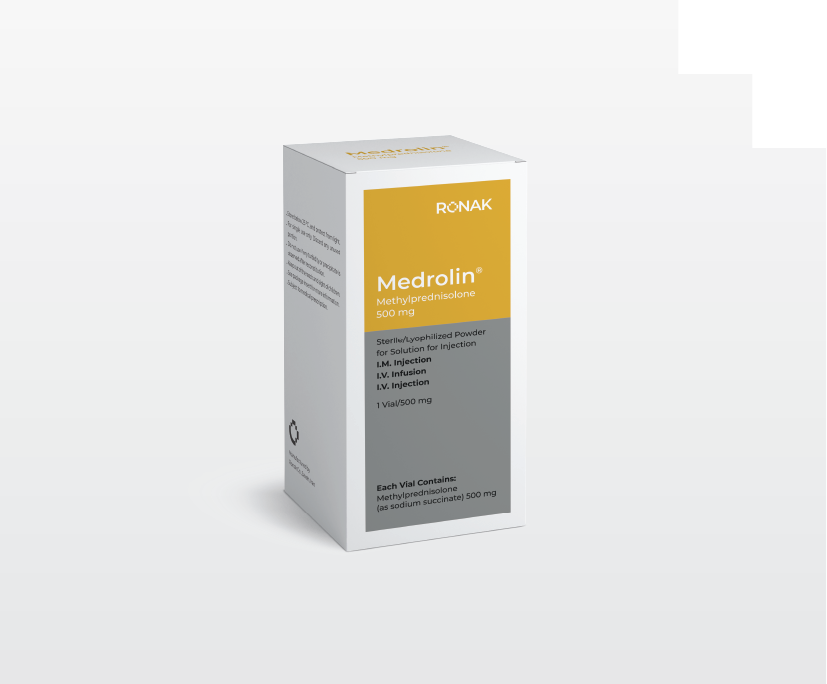
Generic name: Methylprednisolone succinate
Dosage form: Lyophilized powder containing 500 mg methylprednisolone succinate for preparation of injectable solution
Drug class: Systemic corticosteroid
Indications: This medication is used for allergic, inflammatory, hematologic, dermatologic, gastrointestinal, rheumatic, autoimmune, and neurological diseases.
Medrolin®
Medrolin® (methylprednisolone succinate) is a corticosteroid that reduces inflammation through multiple mechanisms.
Indications for Medrolin®
- Various allergies, asthma, and chronic lung diseases such as chronic obstructive pulmonary disease
- Inflammatory, hematologic, dermatologic, gastrointestinal, neoplastic, rheumatic, autoimmune, and neurological disorders
- Blood disorders and malignancies
- Organ transplantation
- Severe, persistent nausea and vomiting during pregnancy
- Thyroid eye disease (exophthalmos)
- Acute respiratory distress syndrome
- Adrenal crisis and Adrenal insufficiency due to classic congenital adrenal hyperplasia
- Secondary treatment of anaphylaxis
- Dermatomyositis/Polymyositis
- Treatment of giant cell arteries
- Treatment of gout acute flares
- Treatment of acute graft-versus-host disease
- Nonvariant primary igA nephropathy
- Immune-mediated adverse reactions associated with checkpoint inhibitor therapy
- Immune thrombocytopenia
- Prevention of iodinated contrast media allergic-like reaction
- Acute exacerbation multiple sclerosis
- Adjunctive therapy for moderate to severe pneumocystis pneumonia
- Castration resistant metastatic prostate cancer
- Severe, acute sarcoidosis
- Organ-threatening or life-threatening systemic rheumatic disorders
- Thyroid eye disease
- Warm autoimmune hemolytic anemia
Dosage Form
Lyophilized powder containing 500 mg methylprednisolone succinate for preparation of injectable solution.
Preparation of Medrolin®
Medrolin® is compatible with the following solutions:
- 0.9% sodium chloride
- 5% dextrose
For IV infusion, dissolve the lyophilized powder by adding sterile water for injection to the vial. Then dilute the prepared solution with one of the compatible solutions above.
The final solution must be clear, without discoloration, foreign particles, or precipitate.
Administration and Dosage of Medrolin®
- Medrolin® can be administered by intramuscular injection, intravenous injection, or intravenous infusion.
- Avoid injection into the deltoid muscle due to a high incidence of subcutaneous atrophy. Avoid injection or leakage into the dermis. Do not inject into areas that have evidence of acute local infection.
- Use requires careful, regular medical supervision during initiation, continuation, and discontinuation.
- Dosage depends on the disease and individual response and should be determined by a specialist.
- After prolonged use, taper the medication gradually.
- High doses must be infused over at least 30 minutes.
- Each vial is single-use; discard any remaining solution after administration.
Monitoring Requirements During Medrolin® Therapy
- Screen for hepatitis B before starting treatment.
- Monitor blood pressure, weight, electrolytes, blood glucose, bone mineral density, and creatine kinase.
- In children, monitor growth and development.
- Assess for infection and suppression of the hypothalamic–pituitary–adrenal axis.
- Patients with tropical exposure or unexplained diarrhea should be evaluated for amebiasis.
- Patients with latent tuberculosis or positive tuberculin tests should be evaluated for reactivation risk.
- For treatments longer than 6 weeks, regular eye exams and intraocular pressure monitoring are required.
- Signs and symptoms of infection.
Contraindications
- Hypersensitivity to methylprednisolone or any component of the formulation
- Systemic fungal infections and untreated infections
- Intrathecal or epidural administration
- Concurrent administration with live or live-attenuated vaccines
- Use in premature infants
- Intramuscular injection in idiopathic thrombocytopenic purpura (ITP)
- Use in patients with ocular herpes simplex, cowpox, or chickenpox—except for short-term or emergency treatment
- High-dose therapy in patients with a history of methylprednisolone-induced toxic hepatitis
- High doses must not be used for head trauma management
- Not suitable for optic neuritis, sepsis syndrome, or systemic sclerosis
Warnings and Precautions
- Increase intake of vitamins B6, C, and D, folate, calcium, and phosphorus and protein during treatment.
- This medication suppresses the immune system and increases infection risk—wash hands regularly and avoid sick individuals. Report fever, chills, severe sore throat, earache, cough, or sputum production.
- Inform your physician if you develop fever, infection, trauma, or require surgery.
- Report new or worsened psychiatric symptoms such as depression, euphoria, insomnia, irritability, or mood changes.
- Report symptoms of high blood sugar: confusion, drowsiness, unusual thirst or hunger, frequent urination, flushing, or rapid breathing.
- Contact a physician if you develop weight gain in the upper back/abdomen, moon face, or severe headache.
- Seek medical advice if you experience severe abdominal pain, vomiting, severe dizziness, fainting, muscle weakness, extreme fatigue, reduced appetite, or weight loss.
- Symptoms of hypokalemia (muscle pain/weakness, cramping, arrhythmia) require immediate reporting.
- Report symptoms of pancreatitis (severe abdominal or back pain, vomiting).
- Report severe headache, dizziness, fainting, or visual changes suggestive of hypertension.
- Report skin changes, pigmented lesions, chest pain, arrhythmias, bone/joint pain, visual disturbances, or limb swelling.
- Use cautiously in patients with heart failure, liver or kidney impairment, hypertension, GI disorders, myocardial infarction history, or seizure disorders.
- Dosage adjustment may be required in thyroid dysfunction.
- Use the lowest effective dose for the shortest duration in elderly patients.
Use During Pregnancy and Breastfeeding
- Consult a physician or pharmacist before using Medrolin® during pregnancy or breastfeeding.
- Whether the medication is appropriate during pregnancy depends on the clinical condition. If used, both mother and fetus should be monitored.
- Decisions about breastfeeding should consider infant exposure, benefits of breastfeeding, and maternal treatment needs.
- If breastfeeding continues during treatment, the infant should be medically monitored.
Side Effects of Medrolin®
Not all patients experience side effects. Possible adverse effects include:
- Excessive sweating
- Headache
- Sleep disturbances
- Increased risk of osteoporosis, septic arthritis, and Kaposi’s sarcoma
- Hypersensitivity reactions
- Injection-site redness and irritation
- Muscle weakness and bone loss
Drug Interactions
Consult your physician or pharmacist before using Medrolin® with other medications or supplements.
Packaging
Each package contains one vial of Medrolin®.
Storage Conditions
- Store at temperatures below 25°C, protected from light and moisture.
- Use before the expiration month printed on the packaging.
- Keep out of reach of children.
- Keep the medication in its original packaging until use.
References
- Methylprednisolone: Drug Information, UpToDate 2025
- electronic Medicines Compendium (eMC)
Medrolin®
Generic name: Methylprednisolone succinate
Dosage form: Lyophilized powder containing 500 mg methylprednisolone succinate for preparation of injectable solution
Drug class: Systemic corticosteroid
Indications: This medication is used for allergic, inflammatory, hematologic, dermatologic, gastrointestinal, rheumatic, autoimmune, and neurological diseases.
Medrolin®
Medrolin® (methylprednisolone succinate) is a corticosteroid that reduces inflammation through multiple mechanisms.
Indications for Medrolin®
- Various allergies, asthma, and chronic lung diseases such as chronic obstructive pulmonary disease
- Inflammatory, hematologic, dermatologic, gastrointestinal, neoplastic, rheumatic, autoimmune, and neurological disorders
- Blood disorders and malignancies
- Organ transplantation
- Severe, persistent nausea and vomiting during pregnancy
- Thyroid eye disease (exophthalmos)
- Acute respiratory distress syndrome
- Adrenal crisis and Adrenal insufficiency due to classic congenital adrenal hyperplasia
- Secondary treatment of anaphylaxis
- Dermatomyositis/Polymyositis
- Treatment of giant cell arteries
- Treatment of gout acute flares
- Treatment of acute graft-versus-host disease
- Nonvariant primary igA nephropathy
- Immune-mediated adverse reactions associated with checkpoint inhibitor therapy
- Immune thrombocytopenia
- Prevention of iodinated contrast media allergic-like reaction
- Acute exacerbation multiple sclerosis
- Adjunctive therapy for moderate to severe pneumocystis pneumonia
- Castration resistant metastatic prostate cancer
- Severe, acute sarcoidosis
- Organ-threatening or life-threatening systemic rheumatic disorders
- Thyroid eye disease
- Warm autoimmune hemolytic anemia
Dosage Form
Lyophilized powder containing 500 mg methylprednisolone succinate for preparation of injectable solution.
Preparation of Medrolin®
Medrolin® is compatible with the following solutions:
- 0.9% sodium chloride
- 5% dextrose
For IV infusion, dissolve the lyophilized powder by adding sterile water for injection to the vial. Then dilute the prepared solution with one of the compatible solutions above.
The final solution must be clear, without discoloration, foreign particles, or precipitate.
Administration and Dosage of Medrolin®
- Medrolin® can be administered by intramuscular injection, intravenous injection, or intravenous infusion.
- Avoid injection into the deltoid muscle due to a high incidence of subcutaneous atrophy. Avoid injection or leakage into the dermis. Do not inject into areas that have evidence of acute local infection.
- Use requires careful, regular medical supervision during initiation, continuation, and discontinuation.
- Dosage depends on the disease and individual response and should be determined by a specialist.
- After prolonged use, taper the medication gradually.
- High doses must be infused over at least 30 minutes.
- Each vial is single-use; discard any remaining solution after administration.
Monitoring Requirements During Medrolin® Therapy
- Screen for hepatitis B before starting treatment.
- Monitor blood pressure, weight, electrolytes, blood glucose, bone mineral density, and creatine kinase.
- In children, monitor growth and development.
- Assess for infection and suppression of the hypothalamic–pituitary–adrenal axis.
- Patients with tropical exposure or unexplained diarrhea should be evaluated for amebiasis.
- Patients with latent tuberculosis or positive tuberculin tests should be evaluated for reactivation risk.
- For treatments longer than 6 weeks, regular eye exams and intraocular pressure monitoring are required.
- Signs and symptoms of infection.
Contraindications
- Hypersensitivity to methylprednisolone or any component of the formulation
- Systemic fungal infections and untreated infections
- Intrathecal or epidural administration
- Concurrent administration with live or live-attenuated vaccines
- Use in premature infants
- Intramuscular injection in idiopathic thrombocytopenic purpura (ITP)
- Use in patients with ocular herpes simplex, cowpox, or chickenpox—except for short-term or emergency treatment
- High-dose therapy in patients with a history of methylprednisolone-induced toxic hepatitis
- High doses must not be used for head trauma management
- Not suitable for optic neuritis, sepsis syndrome, or systemic sclerosis
Warnings and Precautions
- Increase intake of vitamins B6, C, and D, folate, calcium, and phosphorus and protein during treatment.
- This medication suppresses the immune system and increases infection risk—wash hands regularly and avoid sick individuals. Report fever, chills, severe sore throat, earache, cough, or sputum production.
- Inform your physician if you develop fever, infection, trauma, or require surgery.
- Report new or worsened psychiatric symptoms such as depression, euphoria, insomnia, irritability, or mood changes.
- Report symptoms of high blood sugar: confusion, drowsiness, unusual thirst or hunger, frequent urination, flushing, or rapid breathing.
- Contact a physician if you develop weight gain in the upper back/abdomen, moon face, or severe headache.
- Seek medical advice if you experience severe abdominal pain, vomiting, severe dizziness, fainting, muscle weakness, extreme fatigue, reduced appetite, or weight loss.
- Symptoms of hypokalemia (muscle pain/weakness, cramping, arrhythmia) require immediate reporting.
- Report symptoms of pancreatitis (severe abdominal or back pain, vomiting).
- Report severe headache, dizziness, fainting, or visual changes suggestive of hypertension.
- Report skin changes, pigmented lesions, chest pain, arrhythmias, bone/joint pain, visual disturbances, or limb swelling.
- Use cautiously in patients with heart failure, liver or kidney impairment, hypertension, GI disorders, myocardial infarction history, or seizure disorders.
- Dosage adjustment may be required in thyroid dysfunction.
- Use the lowest effective dose for the shortest duration in elderly patients.
Use During Pregnancy and Breastfeeding
- Consult a physician or pharmacist before using Medrolin® during pregnancy or breastfeeding.
- Whether the medication is appropriate during pregnancy depends on the clinical condition. If used, both mother and fetus should be monitored.
- Decisions about breastfeeding should consider infant exposure, benefits of breastfeeding, and maternal treatment needs.
- If breastfeeding continues during treatment, the infant should be medically monitored.
Side Effects of Medrolin®
Not all patients experience side effects. Possible adverse effects include:
- Excessive sweating
- Headache
- Sleep disturbances
- Increased risk of osteoporosis, septic arthritis, and Kaposi’s sarcoma
- Hypersensitivity reactions
- Injection-site redness and irritation
- Muscle weakness and bone loss
Drug Interactions
Consult your physician or pharmacist before using Medrolin® with other medications or supplements.
Packaging
Each package contains one vial of Medrolin®.
Storage Conditions
- Store at temperatures below 25°C, protected from light and moisture.
- Use before the expiration month printed on the packaging.
- Keep out of reach of children.
- Keep the medication in its original packaging until use.
References
- Methylprednisolone: Drug Information, UpToDate 2025
- electronic Medicines Compendium (eMC)