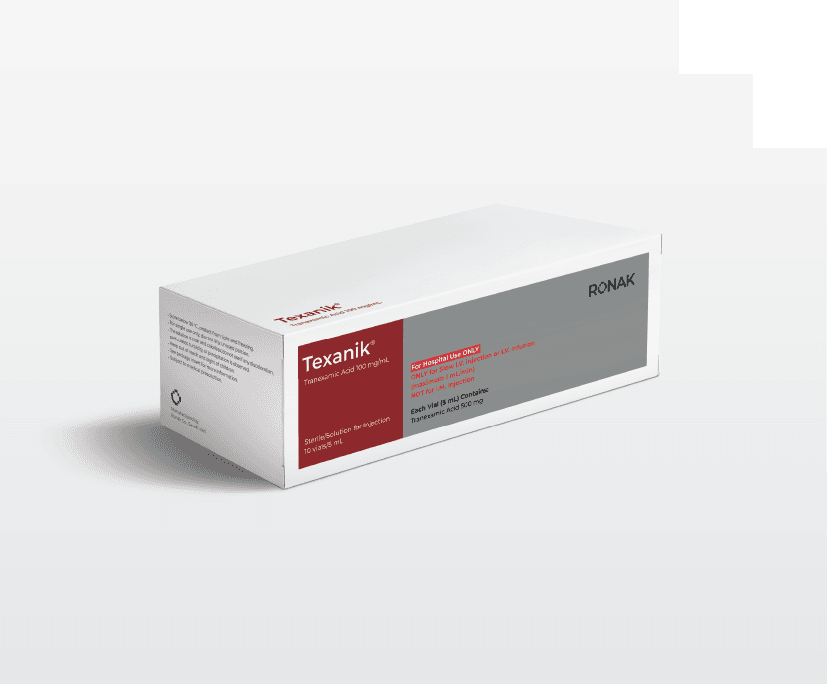


Texanik inj®
Hasta Detayları
Texanik®
Tranexamic Acid
Injection Solution 100 mg/mL
Before you start taking the medication, please read the leaflet carefully.
This medication is prescribed only for your current condition; therefore, avoid using it for similar cases or recommending it to others.
If you need more information, please contact your doctor or pharmacist.
If any side effects worsen or you experience any side effects not mentioned in this leaflet, please consult your doctor or pharmacist.
1. What is Texanik and what is it used for?
Tranexamic Acid belongs to a group of drugs called antihemorrhagic; antifibrinolytic, and amino acid.
It is used to prevent and treat bleeding caused by fibrinolysis in adults and children over 1 year of age.
Tranexamic Acid is specifically used for:
- Heavy menstrual bleeding in women
- Prevention of bleeding and need for blood transfusion in surgery
- Dental surgery in individuals with coagulation disorders
- Gastrointestinal bleeding
- Urinary tract bleeding disorders following prostate surgery or other urinary-related surgeries
- Ear, nose, or throat surgery
- Heart, abdominal, and gynecological surgeries
- Bleeding due to blood-thinning drugs
2. Information you need to know before starting Texanik:
Do not use Tranexamic Acid if you have:
- Allergy to Tranexamic Acid or other ingredients in the formulation.
- Active thromboembolic disease (cerebral thrombosis, deep vein thrombosis, pulmonary embolism)
- History of thrombosis or thromboembolism
- History of retinal vessel occlusion
- Intrinsic risk of thrombosis or thromboembolism (hypercoagulopathy, thrombotic rhythm disorders, thrombotic valvular diseases)
- Patients taking combined hormonal contraceptives at risk of pregnancy.
- Renal issues
- Hematuria (blood in urine)
- History of seizures
Due to the risk of brain edema and seizures, intrathecal, intraventricular, and intracerebral injections are not recommended.
Warnings and precautions:
Inform your doctor or pharmacist if you have:
- Blood in the urinary tract (due to the risk of urinary obstruction)
- Suspected disseminated intravascular coagulation; Tranexamic Acid should be administered with caution and precise evaluation. It is only effective if blood tests show acute severe bleeding from fibrin protein breakdown and activation of the fibrinolytic pathway.
- History of epilepsy; Tranexamic Acid should be prescribed with the lowest dose upon doctor's discretion.
- Prolonged use of Tranexamic Acid may require monitoring for visual disturbances including changes in color vision. Periodic eye exams (visual acuity, color vision tests, fundus evaluation, and visual field assessment) are recommended. If visual changes occur, the medication should be stopped immediately and the patient evaluated by an ophthalmologist.
Thrombotic events: Thromboembolism and arterial and venous thrombosis have been reported with this medication. Tranexamic Acid is contraindicated with pro-coagulant drugs like oral tretinoin and hormonal contraceptive pills.
Use of Texanik with other medications:
Prepare a list of current or recent medications, supplements, and herbal compounds, and inform your doctor or pharmacist. Tranexamic Acid may affect the efficacy of the following:
- Antifibrinolytics (including aminocaproic acid and aprotinin)
- Thrombolytics (alteplase, streptokinase, reteplase, and tenecteplase)
- Oral contraceptives
- Oral tretinoin
Use during pregnancy and breastfeeding:
Consult your doctor or pharmacist if you are pregnant, breastfeeding, might be pregnant, or planning pregnancy before using this medication.
This drug crosses the placenta with fetal blood concentrations similar to maternal plasma levels. Tranexamic Acid should be limited to life-threatening maternal conditions. Only if the benefits to the mother outweigh the potential risks to the fetus, can it be prescribed.
The drug is secreted in breast milk. Decisions regarding its use during breastfeeding should consider risks to the infant, benefits of breastfeeding, and therapeutic advantages for the mother.
Driving and operating machinery:
The effects of this drug on the ability to drive and operate machinery requiring alertness are unknown.
3. How and what amount of Texanik to use:
How to use:
Tranexamic Acid should be administered with careful and regular physician monitoring during initiation, duration, and discontinuation of treatment.
The drug is administered only as a slow intravenous infusion.
Infusion rate should ideally not exceed 1 mL per minute or 100 mg per minute.
Generally, the loading dose of Tranexamic Acid is diluted in 50 to 250 mL of a compatible solution and infused over 5 to 30 minutes.
Avoid intramuscular injection of Tranexamic Acid.
Compatible solutions for dilution:
Tranexamic Acid is compatible with dextrose, sodium chloride, electrolyte-containing solutions, amino acids, and dextran.
Incompatibilities:
Avoid mixing Tranexamic Acid with blood for transfusion or solutions containing penicillin.
Dosage:
The injectable solution of Tranexamic Acid is administered as a slow intravenous infusion.
Your doctor will determine the appropriate dose and duration based on your condition.
Standard treatment for localized fibrinolysis:
Slow intravenous injection or infusion of 1 to 2 vials equivalent to 500 mg to 1000 mg, 2 to 3 times a day.
Standard treatment for systemic fibrinolysis:
Slow intravenous injection or infusion of 1 to 2 vials equivalent to 500 mg to 1000 mg, every 6 to 8 hours equivalent to 15 mg per kg body weight.
Dental surgery in hemophilia patients (with appropriate factor replacement therapy):
Intravenous injection of 10 mg per kg before surgery, then 10 mg per kg at each injection, 3 to 4 times a day for 2 to 8 days as needed.
Children:
For approved pediatric cases aged 1 year and older, Tranexamic Acid dosage is determined by the child’s weight. The doctor will determine the correct dose for the child and the duration of treatment as needed.
Dose adjustment in renal impairment:
For mild to moderate renal insufficiency, Tranexamic Acid dosage is adjusted according to renal clearance, as per the table below:
Serum Creatinine
(mg/dL)
IV Dosage
(mg per kg of body weight)
Dosing Interval
1.35 to 2.82
10
Every 12 hours
2.82 to 5.65
10
Every 24 hours
Above 5.65
5
Every 24 hours
Dose adjustment for 0-18-year-old hemophiliac dental surgery:
Serum Creatinine
(mg/dL)
Maintenance Dose
(10 mg per kg of body weight)
1.36 to 2.83
Twice a day
2.83 to 5.66
Once a day
Above 5.66
10 mg per kg every two days
or 5 mg per kg daily
Dose adjustment in renal impairment during cardiac surgery:
Serum Creatinine
(mg/dL)
Maintenance Infusion Reduction
(mg per kg per hour)
1.6 to 3.3
1.5
3.3 to 6.6
1
Above 6.6
0.5
If you take more Tranexamic Acid than recommended:
In case of accidental ingestion of more than the prescribed amount, consult your doctor or pharmacist immediately as you might experience a temporary drop in blood pressure. Management of Tranexamic Acid overdose is supportive.
4. Possible Side Effects:
As with any medication, alongside desired therapeutic effects, some unwanted side effects may occur, though they do not appear in every individual.
Discontinuation of the medication should occur if any of the following side effects develop or worsen:
Hypersensitivity reactions including anaphylaxis, seizures, visual changes, hematuria, signs of thromboembolism.
Other side effects:
Common side effects (over 10%): Gastrointestinal issues like nausea and vomiting, diarrhea.
Less common side effects (1%-10%): Skin problems like rash.
Uncommon side effects:
- Lethargy and malaise with low blood pressure, especially if administered intravenously rapidly.
- Blood clotting.
- Nervous system effects like seizures.
- Vision disturbances including color vision defects.
- Immune system effects and allergic reactions.
5. Storage conditions:
- Keep the medication away from children's sight and reach.
- Store the medication below 30 degrees Celsius.
- This product is for single-use; discard any remaining medication afterward.
- Avoid using expired medications.
- Store in original packaging, protected from light and freezing.
Sources:
1. BNF 76, September 2018-March 2019, p: 110-1.
2. https://www.medicines.org.uk/emc/files/pil.8953.pdf
3. http://medup.ir/uptodate/contents/mobipreview.htm? 13/58/14248#F229843