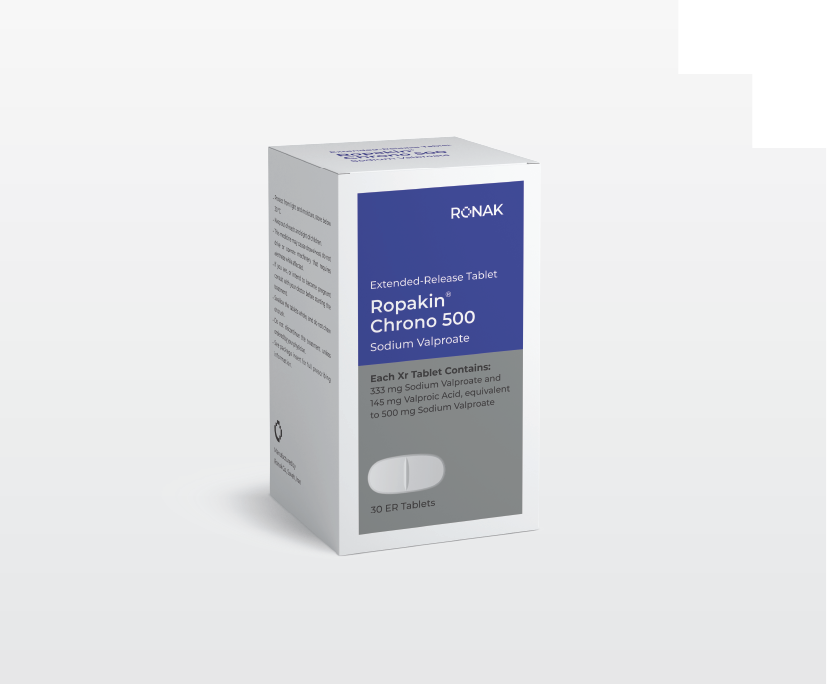





Ropakin Chrono®
Ropakin® Chrono 500
Generic name: Sodium Valproate
Dosage form: 500 mg sustained-release, scored tablet
Drug class: Antiepileptic (Anti-seizure medication)
Indications: This medicine is used for epilepsy, bipolar disorder, and the prevention of migraine headaches.
Ropakin® Chrono
Ropakin® Chrono (sustained-release sodium valproate) is a medication that acts on the nervous system and is used to treat a wide range of disorders. By affecting neurotransmitter activity and inhibiting neuronal signal transmission, it reduces neuronal excitability, helping control seizures and stabilize mood.
Indications of Ropakin® Chrono
- Treatment of various types of epilepsy (partial and generalized)
- Treatment of bipolar disorder
- Prevention of migraine attacks
Dosage Form
500 mg sustained-release, scored tablet
Each Ropakin® Chrono tablet contains:
- 333 mg sodium valproate
- 145 mg valproic acid
Equivalent to 500 mg total valproate activity
Advantages of Ropakin® Chrono
- As a sustained-release (SR) formulation, the active ingredient is released slowly over an extended period.
- This results in more stable blood levels, fewer daily doses, and reduced side effects (especially gastrointestinal effects).
- Because the tablet is scored, it can be split, and breaking the tablet does not change the release rate; drug release remains continuous.
How to Use and Dosage
- Take Ropakin® Chrono exactly as prescribed by your doctor.
- Do not increase, decrease, or discontinue the medication without consulting your physician.
- Do not suddenly stop sodium valproate.
- Do not chew or crush the tablets.
- Not recommended for children under 6 years of age.
If You Miss a Dose
- Take the missed dose as soon as you remember.
- If it is almost time for the next dose, skip the missed one.
- Do not take two doses together or take an extra dose.
Overdose
If you take more than the prescribed dose, contact your doctor immediately or go to a medical center.
Monitoring During Treatment with Ropakin® Chrono
Before starting and during treatment, the following may be checked periodically based on your doctor’s decision:
- Complete blood count
- Bone density
- Coagulation tests
- Plasma valproate levels
- Liver and kidney function tests
- Blood glucose and electrolyte levels (sodium, potassium)
- Urinalysis (for glucose and electrolyte excretion)
- Symptoms of pancreatitis
- Signs of DRESS syndrome (rash, redness, blisters, etc.)
- Symptoms of polycystic ovary syndrome (PCOS)
- Patient’s alertness and mental or motor performance
Contraindications
Do not use Ropakin® Chrono in:
- Hypersensitivity to valproic acid or its derivatives, or to any excipient in the formulation
- Severe hepatic impairment
- Urea cycle disorders
- Suspected POLG-related disorder in children under two years of age
- Known mitochondrial disorders caused by mutations in mitochondrial DNA polymerase γ (POLG)
- Pregnancy, unless no suitable alternative
- Women of childbearing potential, unless the requirements of the Pregnancy Prevention Program are fulfilled
- Porphyria
- Primary carnitine deficiency
Warnings and Precautions
- A small number of patients may experience suicidal thoughts. If this occurs, contact your doctor immediately.
- Seek medical help if you develop signs of liver dysfunction: dark urine, fatigue, loss of appetite, stomach discomfort, pale stools, vomiting, or yellowing of the skin/eyes.
- If symptoms of pancreatitis appear (stomach pain, vomiting, loss of appetite), contact your doctor.
- If you notice decreased alertness, drowsiness, lethargy, or cognitive problems, inform your physician.
- Sodium valproate may increase the risk of bleeding, especially in elderly patients or with high doses.
- If signs of hypersensitivity appear (redness, swelling, blisters, peeling skin, eye redness, mouth or throat ulcers), seek urgent medical care.
- Elderly patients are more sensitive to side effects (such as dehydration and drowsiness), so use with caution.
- Abrupt discontinuation of any antiepileptic drug can increase seizure frequency. Valproate should be tapered gradually.
- Some medications may cause serious interactions with valproate. Inform your doctor about all medicines and supplements you take.
- Inform your doctor if you have had bariatric surgery.
Use During Pregnancy and Breastfeeding
-
Consult your doctor before using sodium valproate during pregnancy or breastfeeding.
-
Use during pregnancy can cause neural tube defects and other congenital malformations in the fetus.
-
If you plan to become pregnant, speak with your doctor.
-
Women of childbearing potential should use effective contraception during treatment.
-
If pregnancy occurs, do not stop the medication suddenly—seek medical advice immediately.
-
Estrogen-containing contraceptives (e.g., LD, Yaz, Rokin, etc.) can reduce blood valproate levels, increasing the risk of seizures—your doctor should choose the best contraceptive method for you.
-
Sodium valproate is excreted in breast milk; consult your physician before breastfeeding.
Possible Side Effects
Not everyone experiences side effects, but possible reactions include:
-
Headache, fatigue, fever
-
Nausea, vomiting, abdominal pain, diarrhea, loss of appetite, indigestion, constipation
-
Tremor, dizziness, double vision, blurred vision, nystagmus
-
Balance problems, emotional instability, cognitive impairment, memory issues
-
Flu-like symptoms, respiratory infections, runny nose
-
Weight gain or loss
-
Hair loss
-
Sleepiness, tiredness, weakness, dizziness
-
Sleep disturbances (especially in older adults)
Drug Interactions
Consult your doctor or pharmacist before using sodium valproate with any other medicines or supplements.
Packaging
Each bottle contains 30 tablets.
Storage Conditions
-
Keep the medicine out of sight and reach of children.
-
Store below 30°C, away from light and moisture.
-
Use the medication until the end of the month indicated on the expiry date.
-
Do not use expired medications.
-
Keep the tablets in their original packaging.
References
-
Valproate (Valproic Acid): Drug Information, UpToDate 2025
-
Electronic Medicines Compendium (emc) product details
-
Valproic Acid: FDA Label 2025
Ropakin® Chrono 500
Generic name: Sodium Valproate
Dosage form: 500 mg sustained-release, scored tablet
Drug class: Antiepileptic (Anti-seizure medication)
Indications: This medicine is used for epilepsy, bipolar disorder, and the prevention of migraine headaches.
Ropakin® Chrono
Ropakin® Chrono (sustained-release sodium valproate) is a medication that acts on the nervous system and is used to treat a wide range of disorders. By affecting neurotransmitter activity and inhibiting neuronal signal transmission, it reduces neuronal excitability, helping control seizures and stabilize mood.
Indications of Ropakin® Chrono
- Treatment of various types of epilepsy (partial and generalized)
- Treatment of bipolar disorder
- Prevention of migraine attacks
Dosage Form
500 mg sustained-release, scored tablet
Each Ropakin® Chrono tablet contains:
- 333 mg sodium valproate
- 145 mg valproic acid
Equivalent to 500 mg total valproate activity
Advantages of Ropakin® Chrono
- As a sustained-release (SR) formulation, the active ingredient is released slowly over an extended period.
- This results in more stable blood levels, fewer daily doses, and reduced side effects (especially gastrointestinal effects).
- Because the tablet is scored, it can be split, and breaking the tablet does not change the release rate; drug release remains continuous.
How to Use and Dosage
- Take Ropakin® Chrono exactly as prescribed by your doctor.
- Do not increase, decrease, or discontinue the medication without consulting your physician.
- Do not suddenly stop sodium valproate.
- Do not chew or crush the tablets.
- Not recommended for children under 6 years of age.
If You Miss a Dose
- Take the missed dose as soon as you remember.
- If it is almost time for the next dose, skip the missed one.
- Do not take two doses together or take an extra dose.
Overdose
If you take more than the prescribed dose, contact your doctor immediately or go to a medical center.
Monitoring During Treatment with Ropakin® Chrono
Before starting and during treatment, the following may be checked periodically based on your doctor’s decision:
- Complete blood count
- Bone density
- Coagulation tests
- Plasma valproate levels
- Liver and kidney function tests
- Blood glucose and electrolyte levels (sodium, potassium)
- Urinalysis (for glucose and electrolyte excretion)
- Symptoms of pancreatitis
- Signs of DRESS syndrome (rash, redness, blisters, etc.)
- Symptoms of polycystic ovary syndrome (PCOS)
- Patient’s alertness and mental or motor performance
Contraindications
Do not use Ropakin® Chrono in:
- Hypersensitivity to valproic acid or its derivatives, or to any excipient in the formulation
- Severe hepatic impairment
- Urea cycle disorders
- Suspected POLG-related disorder in children under two years of age
- Known mitochondrial disorders caused by mutations in mitochondrial DNA polymerase γ (POLG)
- Pregnancy, unless no suitable alternative
- Women of childbearing potential, unless the requirements of the Pregnancy Prevention Program are fulfilled
- Porphyria
- Primary carnitine deficiency
Warnings and Precautions
- A small number of patients may experience suicidal thoughts. If this occurs, contact your doctor immediately.
- Seek medical help if you develop signs of liver dysfunction: dark urine, fatigue, loss of appetite, stomach discomfort, pale stools, vomiting, or yellowing of the skin/eyes.
- If symptoms of pancreatitis appear (stomach pain, vomiting, loss of appetite), contact your doctor.
- If you notice decreased alertness, drowsiness, lethargy, or cognitive problems, inform your physician.
- Sodium valproate may increase the risk of bleeding, especially in elderly patients or with high doses.
- If signs of hypersensitivity appear (redness, swelling, blisters, peeling skin, eye redness, mouth or throat ulcers), seek urgent medical care.
- Elderly patients are more sensitive to side effects (such as dehydration and drowsiness), so use with caution.
- Abrupt discontinuation of any antiepileptic drug can increase seizure frequency. Valproate should be tapered gradually.
- Some medications may cause serious interactions with valproate. Inform your doctor about all medicines and supplements you take.
- Inform your doctor if you have had bariatric surgery.
Use During Pregnancy and Breastfeeding
-
Consult your doctor before using sodium valproate during pregnancy or breastfeeding.
-
Use during pregnancy can cause neural tube defects and other congenital malformations in the fetus.
-
If you plan to become pregnant, speak with your doctor.
-
Women of childbearing potential should use effective contraception during treatment.
-
If pregnancy occurs, do not stop the medication suddenly—seek medical advice immediately.
-
Estrogen-containing contraceptives (e.g., LD, Yaz, Rokin, etc.) can reduce blood valproate levels, increasing the risk of seizures—your doctor should choose the best contraceptive method for you.
-
Sodium valproate is excreted in breast milk; consult your physician before breastfeeding.
Possible Side Effects
Not everyone experiences side effects, but possible reactions include:
-
Headache, fatigue, fever
-
Nausea, vomiting, abdominal pain, diarrhea, loss of appetite, indigestion, constipation
-
Tremor, dizziness, double vision, blurred vision, nystagmus
-
Balance problems, emotional instability, cognitive impairment, memory issues
-
Flu-like symptoms, respiratory infections, runny nose
-
Weight gain or loss
-
Hair loss
-
Sleepiness, tiredness, weakness, dizziness
-
Sleep disturbances (especially in older adults)
Drug Interactions
Consult your doctor or pharmacist before using sodium valproate with any other medicines or supplements.
Packaging
Each bottle contains 30 tablets.
Storage Conditions
-
Keep the medicine out of sight and reach of children.
-
Store below 30°C, away from light and moisture.
-
Use the medication until the end of the month indicated on the expiry date.
-
Do not use expired medications.
-
Keep the tablets in their original packaging.
References
-
Valproate (Valproic Acid): Drug Information, UpToDate 2025
-
Electronic Medicines Compendium (emc) product details
-
Valproic Acid: FDA Label 2025